Reviewing at the pace of coding agents
How does a five-developer team review the code its agents produce? CodeVoucher documents its use inside Pyratz Labs over the period from 13 August to 5 November 2026. This is an editorial summary of that first-party case study: Pyratz Labs builds CodeVoucher, so these results are not an independent benchmark.
Repeated reviews, not just a first pass
Across 18 repositories, the workspace recorded 5,000 review runs covering 1,834 merge requests. A new push or requested re-review starts another run. The study reports an average of 2.7 review rounds per merge request, with 51% reviewed at least twice. The point is not simply more code: review needs to follow each revision as it changes.
What the findings do and do not establish
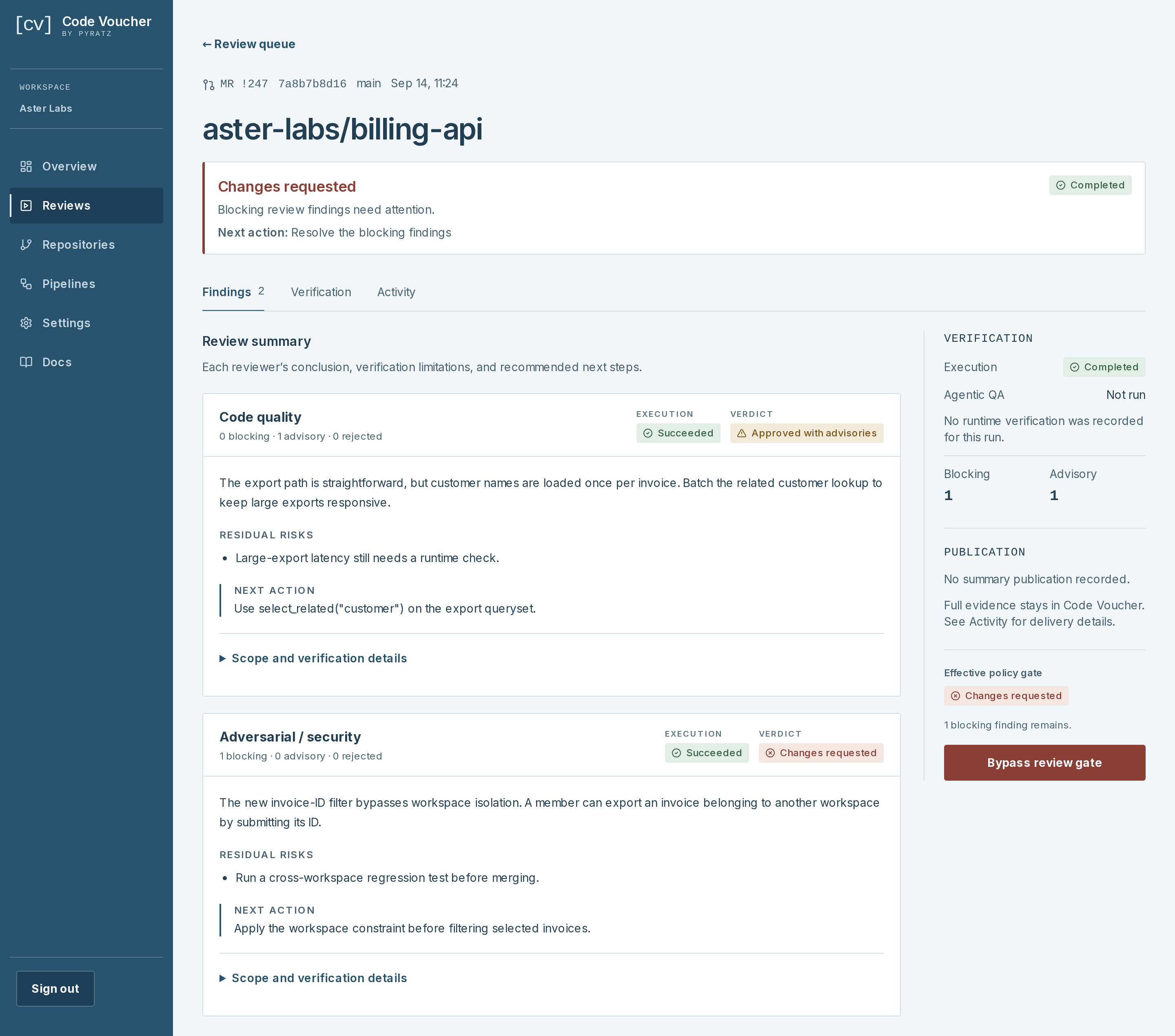
CodeVoucher combines code-quality review with adversarial security review. The study reports 3,220 findings and 197 merges stopped by a blocking finding. These are counts of reported findings and blocked merges, not a count of confirmed vulnerabilities or proof of review accuracy. The team has not adjudicated every finding and makes no precision or recall claims.
The full case study explains the counting method, weekly activity, review bursts and use of an existing Codex subscription. It also links to a review published on a public Paseo Rooms pull request. Read it on CodeVoucher for the charts, source notes and limitations.
Read the full CodeVoucher case study (in English) →
Paseo Rooms: bring your team into the agent conversation
Why we built shared, encrypted rooms around existing coding-agent sessions—and how Paseo’s daemon, structured questions and image sharing make collaboration possible.
Pyratz2036 — Harnessing the power of intelligence responsibly
An investment thesis for the intelligence age: back the technologies that create abundance, the scarce resources they depend on and the regulated institutions that enable their deployment, while preserving ownership, choice and human agency.
The Software Factory
Agentic coding is changing the unit of software production: the developer increasingly designs, supervises, and improves a factory of connected build, audit, deployment, and operating systems.