2036–2050: the possibility corridor
2036 is not the date by which Pyratz expects the future to arrive. It is the date by which Pyratz expects to be accountable for whether it is ready. Between 2036 and 2050, several limits that have organized human life may move at once—not as one synchronized prophecy, but as an expanding corridor of possibility.
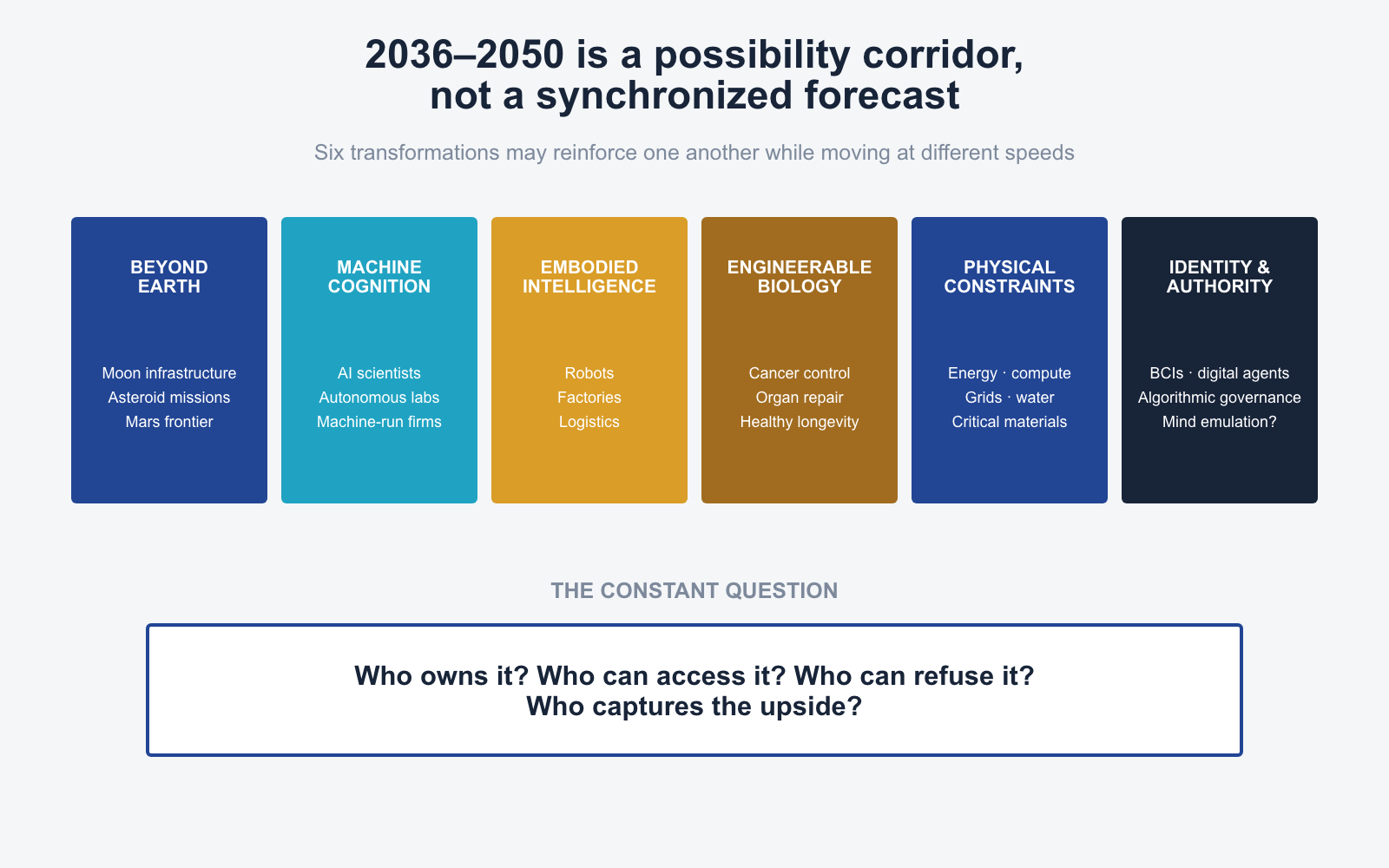
Human economic activity may begin to extend beyond Earth. Permanent infrastructure on or around the Moon could support communications, navigation, science, energy and logistics. Robotic missions may prospect or extract resources from asteroids before a mature commercial market exists. Mars may host early human or machine-supported settlements. None of these outcomes is guaranteed on this timetable; each is a horizon signal that ownership, property, sovereignty and stewardship may soon have to operate across worlds, not only across borders.[1]
At the same time, machine cognition may become a scientific and economic actor: AI researchers generating hypotheses, autonomous laboratories running experiments, and companies whose routine operations are performed largely by machines. Intelligence may enter the physical world through humanoid robots, autonomous factories and logistics. Biology may become increasingly engineerable—more cancers prevented, cured or managed; organs repaired or replaced; and healthy life extended. Compute, electricity, grids, water and critical materials may become the binding constraints on that abundance, even if fusion or other energy breakthroughs eventually loosen them.
Identity and authority may also become machine-mediated. Brain–computer interfaces could restore lost function and extend memory; digital agents may speak and transact on our behalf; programmable money and algorithmic governance may decide who can participate. At the furthest horizon lies the disputed possibility of partial mind emulation or consciousness upload. It should be named because it exposes the ultimate agency question, not because Pyratz predicts it by 2050: if aspects of a person can be copied, hosted or controlled, who owns the infrastructure—and who has the right to alter, refuse or end it?
The future may be more abundant than we can imagine. Here, abundance does not mean the disappearance of scarcity. It means that artificial intelligence makes cognition and expertise cheap and scalable, while robotics converts that intelligence into physical production—allowing a growing range of goods and services to be produced at radically lower cost and with diminishing dependence on human labour. Intelligence, expertise and productive capacity may become plentiful; energy, materials, land, infrastructure, trust, regulated access, ownership and political power may not.
That makes ownership and agency impossible to postpone. Before asking what Pyratz should invest in, we must ask: what becomes abundant, what remains scarce, and what must people and Europe own to remain authors of their lives?
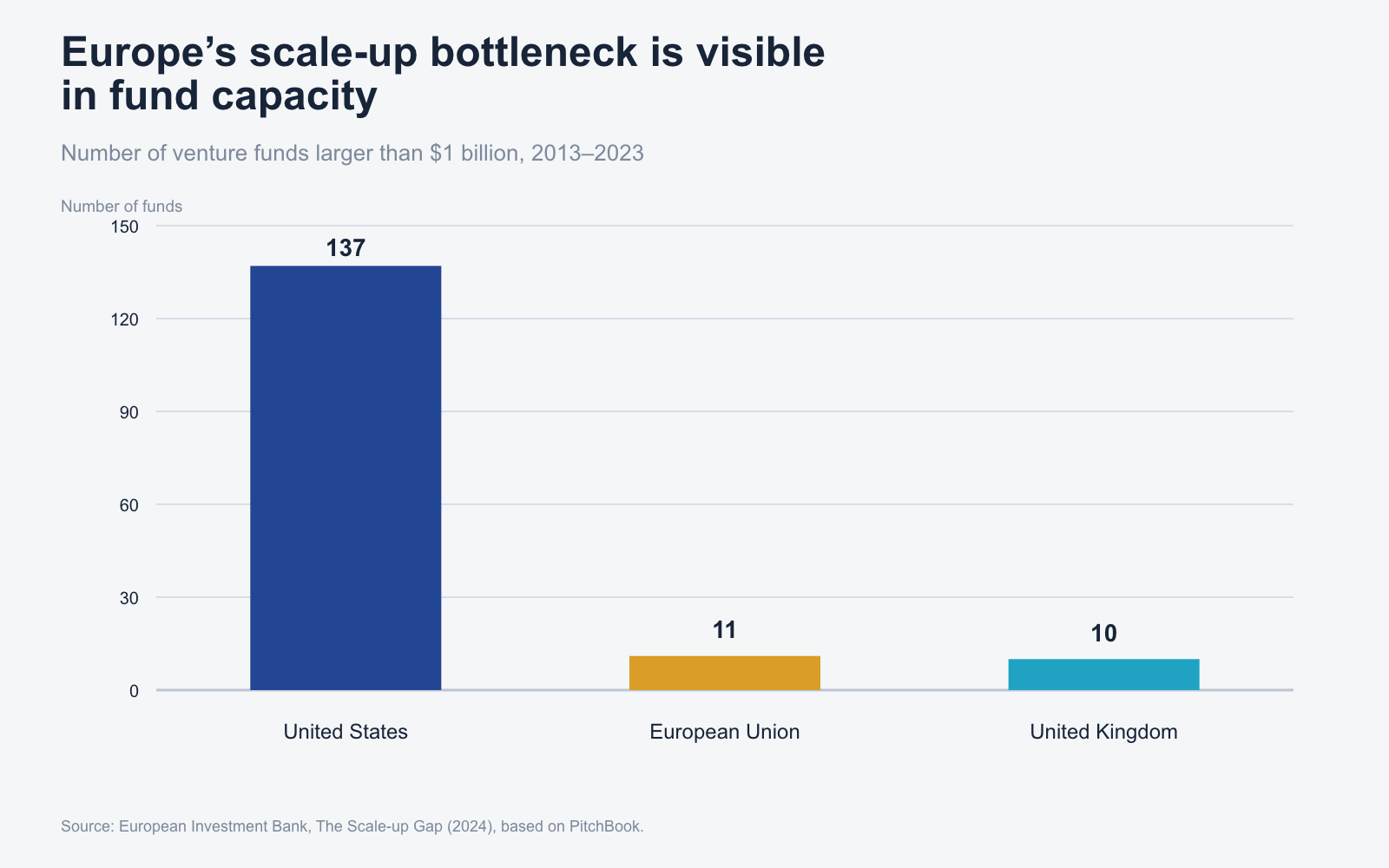
Europe has repeatedly helped create important technologies without retaining a proportionate share of their later ownership, decision-making power or industrial capacity. This is not universal, and it is not inevitable. But it is measurable. European Union scale-ups raise roughly half as much capital as comparable San Francisco firms over their first decade; more than four in five EU scale-up deals involve a foreign lead or sole investor, compared with 14% in San Francisco; and from 2013 to 2023 the United States produced 137 venture funds larger than $1 billion, against 11 in the EU.[2] It is a pattern Pyratz intends to change.
It educates scientists, produces founders, finances early risk and develops technologies with global importance. Then, too often, the decisive capital, infrastructure, distribution and ownership accumulate elsewhere. The company may remain European by origin while its strategic centre of gravity moves abroad. The public can use what was created, but it does not necessarily share in the ownership, bargaining power or decisions that follow.
This pattern matters more as machine intelligence becomes a general productive capability. A continent can have excellent access to artificial intelligence and still become dependent on systems it cannot govern, infrastructure it does not control and assets whose appreciation benefits owners elsewhere. An individual can enjoy extraordinarily capable services and still possess less privacy, less bargaining power and less ability to contest the decisions shaping his life.
That is the paradox at the centre of the coming decade: intelligence may become abundant while human agency becomes scarce. Human agency is the capacity to form our own goals, make meaningful choices, act on them, and retain the power to question, refuse or change the systems that shape our lives. In plain language, it is choice, ownership and the power to act.
The future is therefore not a simple contest between technological progress and resistance to it. We do not want to slow the revolution in order to preserve an increasingly obsolete status quo. Pyratz wants to be inside it: close enough to the laboratories, founders, machines and capital flows to understand what is changing and to retain maximum optionality. But participation is not surrender. The central question is whether technological capability will expand the number of people able to act, choose and own—or merely make dependence more comfortable.
Three distinctions guide us.
Abundance is not agency. Access is not ownership. Optimization is not freedom.
They are warnings against three category errors that can produce a prosperous but diminished society.
The world we are preparing for
The exact timetable is unknowable. Machine intelligence may compound rapidly inside a handful of laboratories, or diffuse unevenly over decades as energy, compute, regulation and physical deployment slow it down. Pyratz does not need a prophecy to act. In either case, more cognition will be produced by machines, decision cycles will compress, and value will migrate toward what intelligence cannot instantly reproduce.[3]
That migration is the economic heart of the Pyratz thesis.
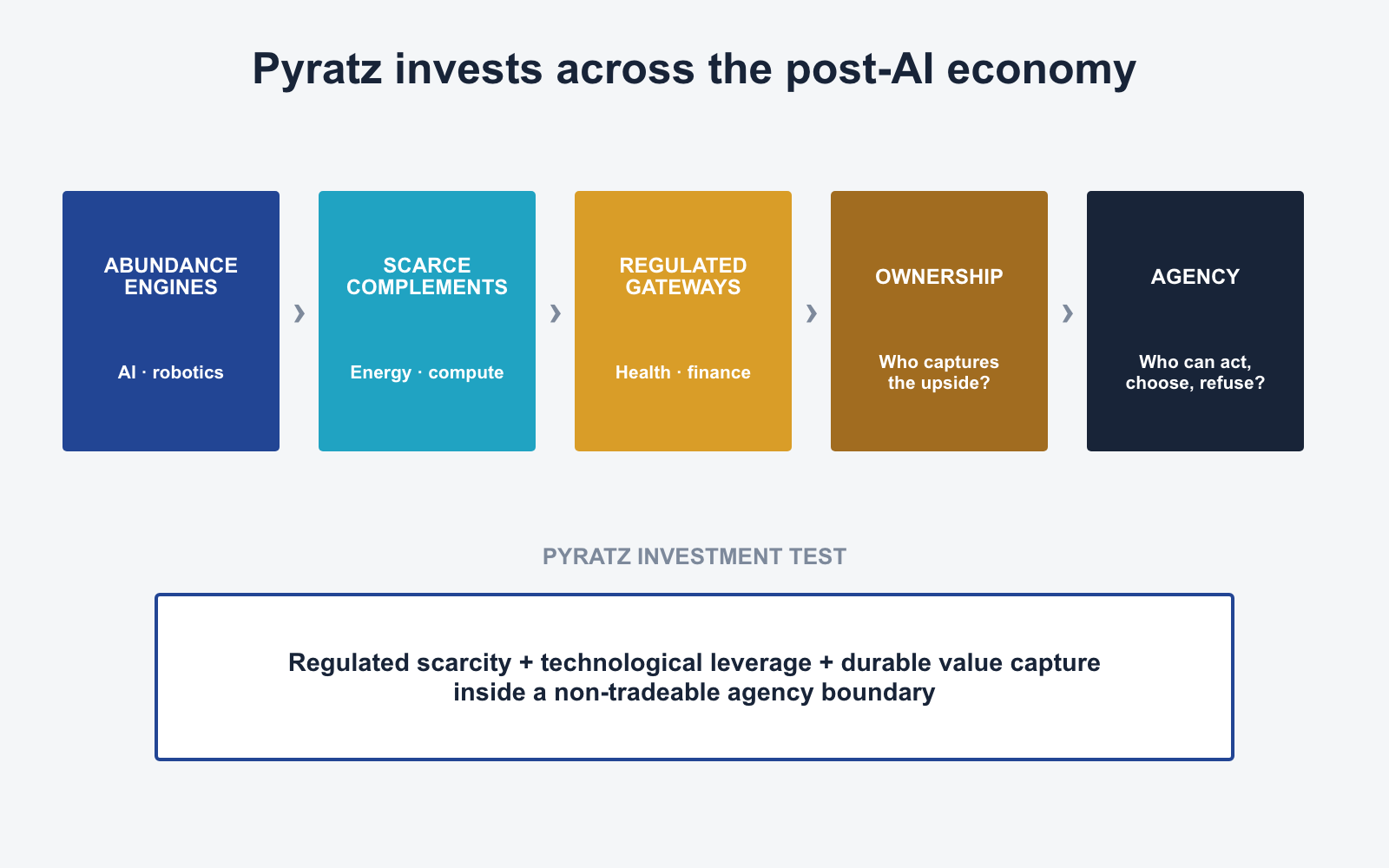
Pyratz is not investing only in AI. It is investing in the economy that emerges after intelligence becomes abundant. That economy has three investable layers. The first is the abundance engines: AI, robotics, autonomous laboratories and machine-run production. The second is the scarce complements: energy, compute, physical infrastructure, proprietary data, land, distribution and trusted networks. The third is the regulated gateways: healthcare, finance, insurance, defence, identity, energy and mobility—the institutions through which machine capability receives legal permission, social trust and access to the real economy.
These gateways are not a defensive side bet or a euphemism for protected incumbents. They can become control points of the post-AI economy because technical capability does not authorize its own deployment. AI may make diagnosis abundant; clinical validation, reimbursement and licensed delivery determine whether a patient receives treatment. AI may make financial analysis abundant; regulated institutions determine who can custody, distribute and own assets. Robots may make production abundant; energy systems, insurance, certification and physical infrastructure determine whether they can operate at scale.
The investable conjunction is therefore regulated scarcity with technological leverage: licences, trust, proprietary data, capital or distribution create a durable and legitimate moat, while AI materially improves the product, access or economics. Regulation alone is not a moat worth owning; captured regulation can protect rents while blocking progress. Pyratz looks for gateways whose advantage compounds with technological capability and whose success expands human agency rather than converting permission into dependence.
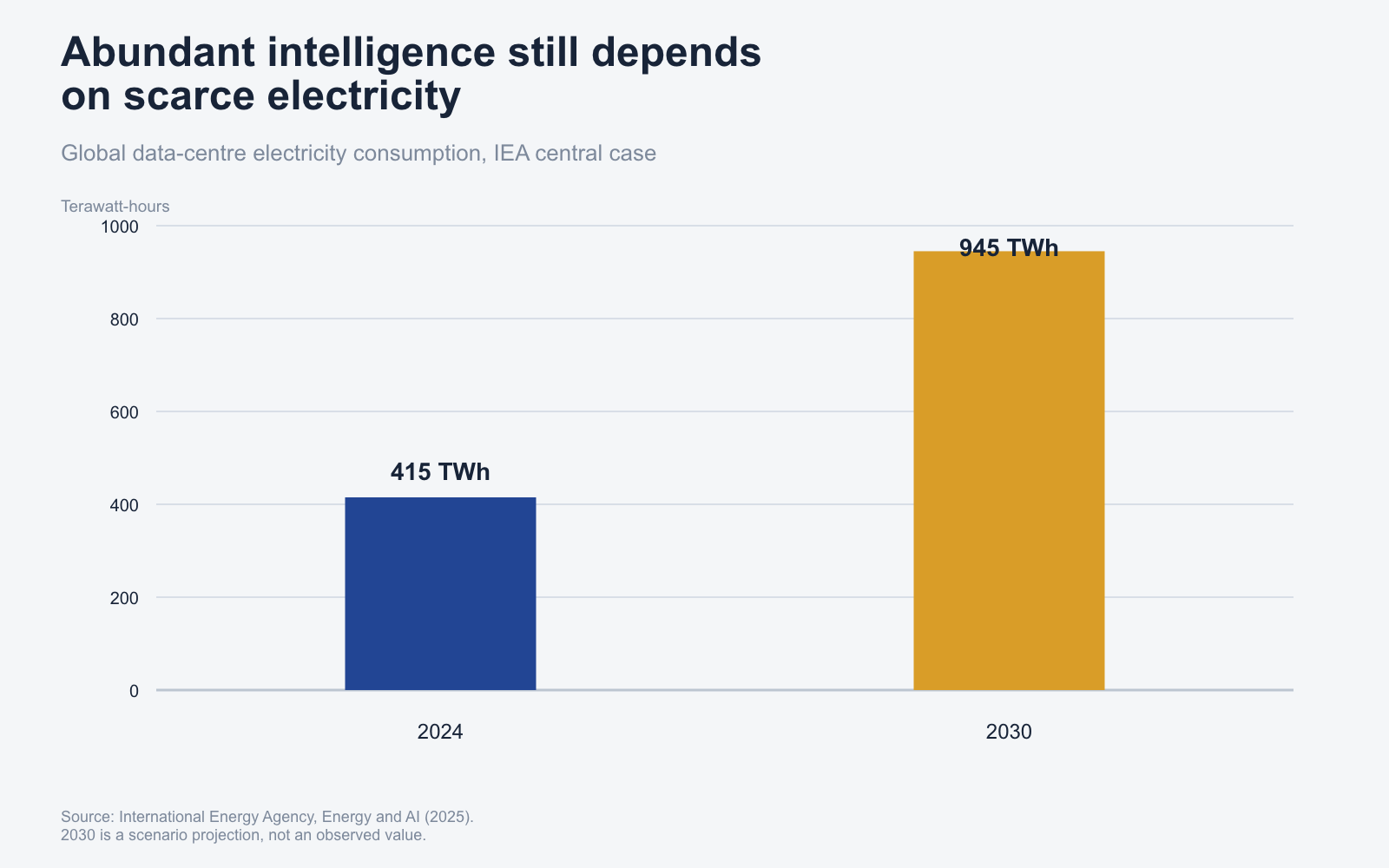
When software can reason, write and design at falling cost, intelligence does not make the rest of the economy weightless. It collides with the physical and institutional world: energy and compute; trusted data; physical deployment; regulation; and distribution. Intelligence can accelerate discovery, but it cannot instantly reproduce a power grid, a clinical trial, a factory, a licence or public trust. The International Energy Agency estimates that data centres consumed about 415 TWh of electricity in 2024 and projects 945 TWh in 2030 in its base case. That forecast is uncertain, but the asymmetry in lead times is not: a data centre can be deployed in two or three years while energy infrastructure usually requires longer planning, construction and capital cycles.[4]
These complements will not all capture value automatically. Competition can compress the margins of data centres, energy suppliers or manufacturers just as it compresses software. States can regulate rents; standards can move value to customers; technical substitution can make yesterday’s bottleneck abundant. We therefore do not invest in a list of fashionable sectors. We look for a specific conjunction: a scarce complement whose scarcity is durable, whose owner can capture a fair share of the value created, and whose deployment expands rather than silently removes human agency.
This leads us toward scientific and industrial systems, from compute and energy to trusted data, physical production, healthcare, financial infrastructure and space. They are not equal-weight categories, and “the future” is not an investable thesis. Each opportunity must establish where scarcity comes from, who captures the value, what evidence will arrive and what happens to human choice if the company succeeds.
Why access is insufficient
The dominant promise of the digital age has been access. More people can communicate, publish, learn, transact and use capabilities once reserved for large institutions. That achievement is real. But access is usually conditional. A platform may change its rules, its price, its ranking system or its permissions. A model may be withdrawn. An account may be closed. A person’s work, audience or history may remain trapped inside an infrastructure he does not govern.
Ownership can change the bargaining position, but the word conceals different rights. Outside investors may hold beneficial economic exposure without any direct vote over an underlying company. Pyratz may separately hold stewardship rights—board representation, information, consent or audit rights—on their behalf. Direct shareholders may possess still other rights. In a labour-light economy, economic participation may become a more important source of income and independence. That is why we believe people should not only use the future; they should be able to own part of it. We will not pretend that economic exposure automatically confers control.
But we should not pretend that any equity exposure equals agency. A passive minority interest in an opaque and illiquid vehicle can distribute risk without distributing voice. Ownership does not create purpose, civic standing or personal freedom by itself. Public institutions, competition, privacy rights, interoperability and the ability to leave remain essential. The relevant question is not “Is it owned by humans?” Every company and state already satisfies that description. The question is how concentrated, contestable and accountable ownership is—and which rights accompany it.
Pyratz cannot promise equal distribution of abundance. No private institution can. What it can do is build productive assets, retain meaningful European participation in them and develop responsible pathways for broader economic participation. Today that bridge is weak. Euro-area households held about 35% of their financial assets in cash and deposits in 2022, compared with 13% in the United States, while shares and other equity represented about 23% in the euro area and 40% in the United States.[5] The point is not that every deposit should become venture capital. It is that Europe has savings without enough trusted, transparent channels connecting those savings to long-duration productive ownership.
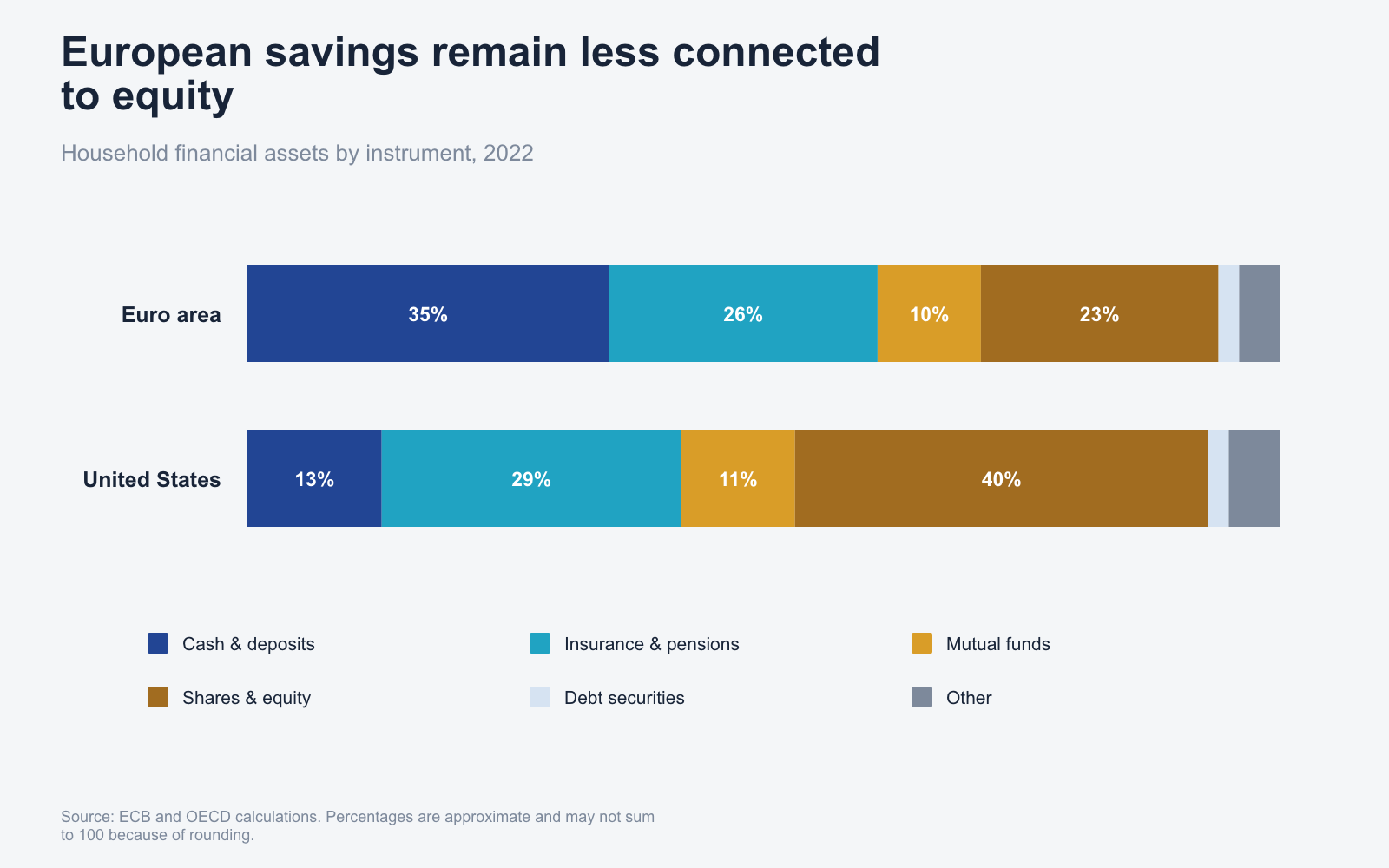
That requires separating three layers that are too often blurred. Pyratz’s stewardship and control rights determine how assets are governed. Outside investors’ economic rights determine how gains and losses are shared. The vehicle’s liquidity terms determine when, and at what cost, investors can leave. Broad access will not be offered until the duration of the liabilities, redemption design, valuation policy, fees, concentration and suitability rules match the underlying assets. A listed vehicle may provide tradability without redemption at net asset value; a private vehicle may provide patient capital without daily liquidity. Neither should be sold as something it is not. Broad economic participation need not mean dispersed control, so Pyratz itself must remain accountable through independent oversight, transparent reporting and rights that protect outside investors from self-dealing.
This mechanism is not finished. The doctrine is therefore a commitment to institutional design, not a claim of accomplishment.
Agency beyond economics
Agency is more than economic participation. It is the capacity to form aims, revise them and act without covert manipulation. It includes privacy, dissent, the right to remain unoptimized and the ability to leave a system on which one depends.
This becomes harder when machines do not merely answer questions but anticipate preferences, select information, recommend relationships and act on a person’s behalf. A system can expand immediate capability while narrowing the environment in which preferences are formed. “Human in the loop” can become ceremonial when the machine acts faster than the person can understand or challenge. This is already an operating question, not only a philosophical one. An OECD survey of more than 6,000 firms across six countries found algorithmic-management tools already widely used and reported recurring concerns about unclear accountability, opaque logic and inadequate protection of worker health.[6]
We should therefore avoid the easy claim that automation will free everyone for relationships, creation and mastery. It may. It may also erode the economic and social structures from which status, purpose and community are currently made. Capital cannot decide what a human life is for. It can, however, protect some of the conditions in which people remain able to decide: plural systems rather than a single gatekeeper; private spaces beyond continuous optimization; accountable decision-makers; meaningful veto and exit rights; and economic participation in productive assets.
The objective is not to keep humans performing tasks machines can do better. It is to prevent efficiency from becoming the only value by which human arrangements are judged.
Healthcare: the hardest test
Any doctrine linking ownership, agency and return must survive the place where human need is greatest and scarcity is most morally consequential: healthcare.
If drug-design intelligence becomes cheap, biological data, wet laboratories, clinical recruitment, regulatory proof, manufacturing, reimbursement and trusted delivery become more decisive. Discovery costs may fall while total spending rises because new treatments create new demand, populations live longer and scarcity moves downstream. A breakthrough may be scientifically abundant and economically inaccessible for years. In 2023, patients paid 35.5% of EU retail pharmaceutical spending out of pocket, compared with roughly 20% of total health spending paid privately; at EU level, 6% of households experienced catastrophic health spending, with outpatient medicines driving one-third of those cases.[7] Scientific abundance and affordable delivery are demonstrably different achievements.
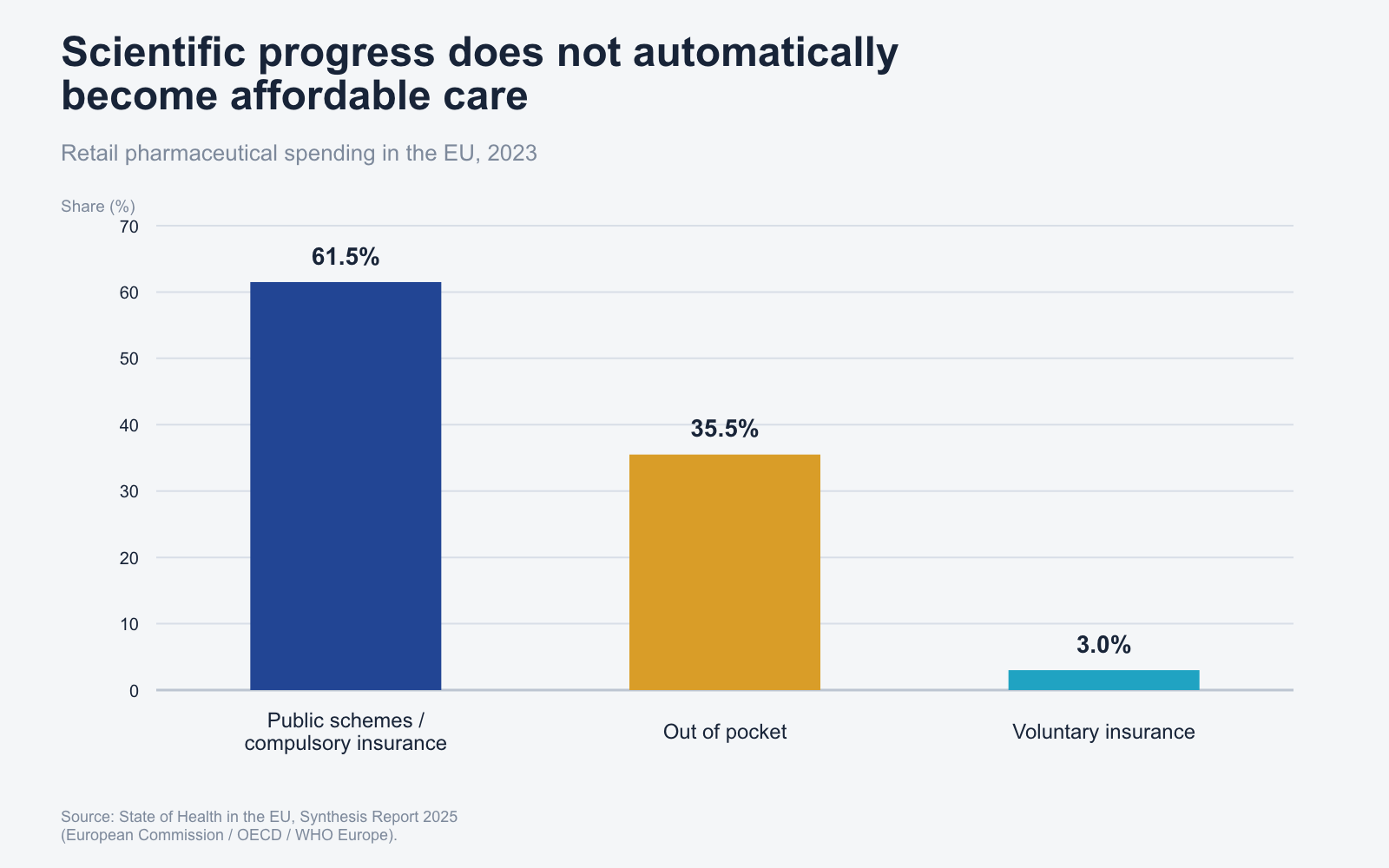
The question is not simply whether a company lowers discovery cost. It is who pays, who captures the saving, how access expands, what happens to patient data and whether scarcity is transitional or the business model itself.
There will be difficult cases. Consider a longevity treatment that produces extraordinary benefit but can initially serve only a small number of wealthy patients. Pyratz need not reject it merely because access begins unevenly; almost every new physical technology begins scarce. But we would require a credible path to scale, a governance position capable of influencing pricing and access, protection of genetic and clinical data, and evidence that scarcity is a transitional constraint rather than the business model itself. If monopoly pricing is the only source of exceptional return and wider access would destroy the economics, the company contradicts the doctrine.
Returns remain essential. Long-duration science cannot be financed by moral language. Pyratz therefore maximizes risk-adjusted long-term returns inside an agency boundary. It does not trade away that boundary for incremental return. This hierarchy must be encoded in each vehicle’s mandate so that investors understand the constraint before committing capital.
The European wager
Pyratz is European in character and global in opportunity.
That phrase must carry obligations, not nostalgia. Europe is not uniformly pluralistic, privacy-preserving or wise. Its fragmented capital markets, energy costs, regulatory complexity and suspicion of scale can turn legitimate safeguards into strategic weakness. Too often Europe regulates the future after failing to finance it. The ownership pattern is visible inside AI itself: of the venture capital invested in EU-headquartered AI and data companies from 2014 to 2024, only 31% came from EU investors; 42% came from the United States. Among listed EU AI firms, domestic investors hold only about half of the equity, while US investors hold nearly one-third.[8]
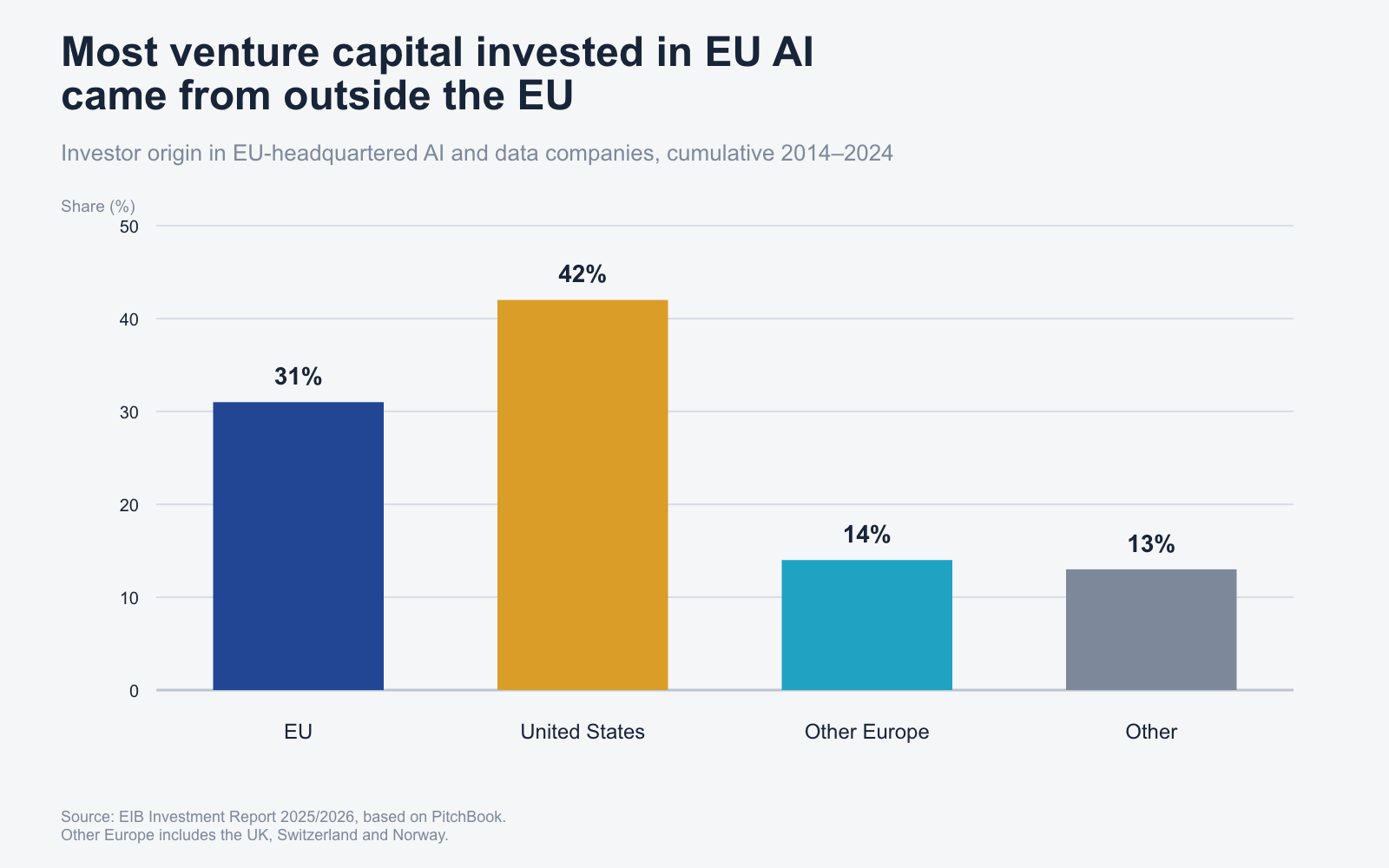
Pyratz chooses to defend commitments rooted in European legal and institutional traditions: dignity of the individual, limits on concentrated authority, pluralism, private life and the belief that markets exist inside a social order rather than above it. These commitments are neither uniquely European nor consistently upheld by Europe; they matter because powerful technologies make concentration economically tempting.
Investing globally is not a contradiction if global participation strengthens the institution’s ability to build, finance and retain European capability. But a European balance sheet owning small stakes in foreign monopolies is not sovereignty. The test is whether Pyratz brings knowledge, decision rights, strategic relationships, capital formation and ownership back into a durable European institution; whether it helps European companies scale without premature surrender; and whether its global holdings comply with the same agency standards applied at home.
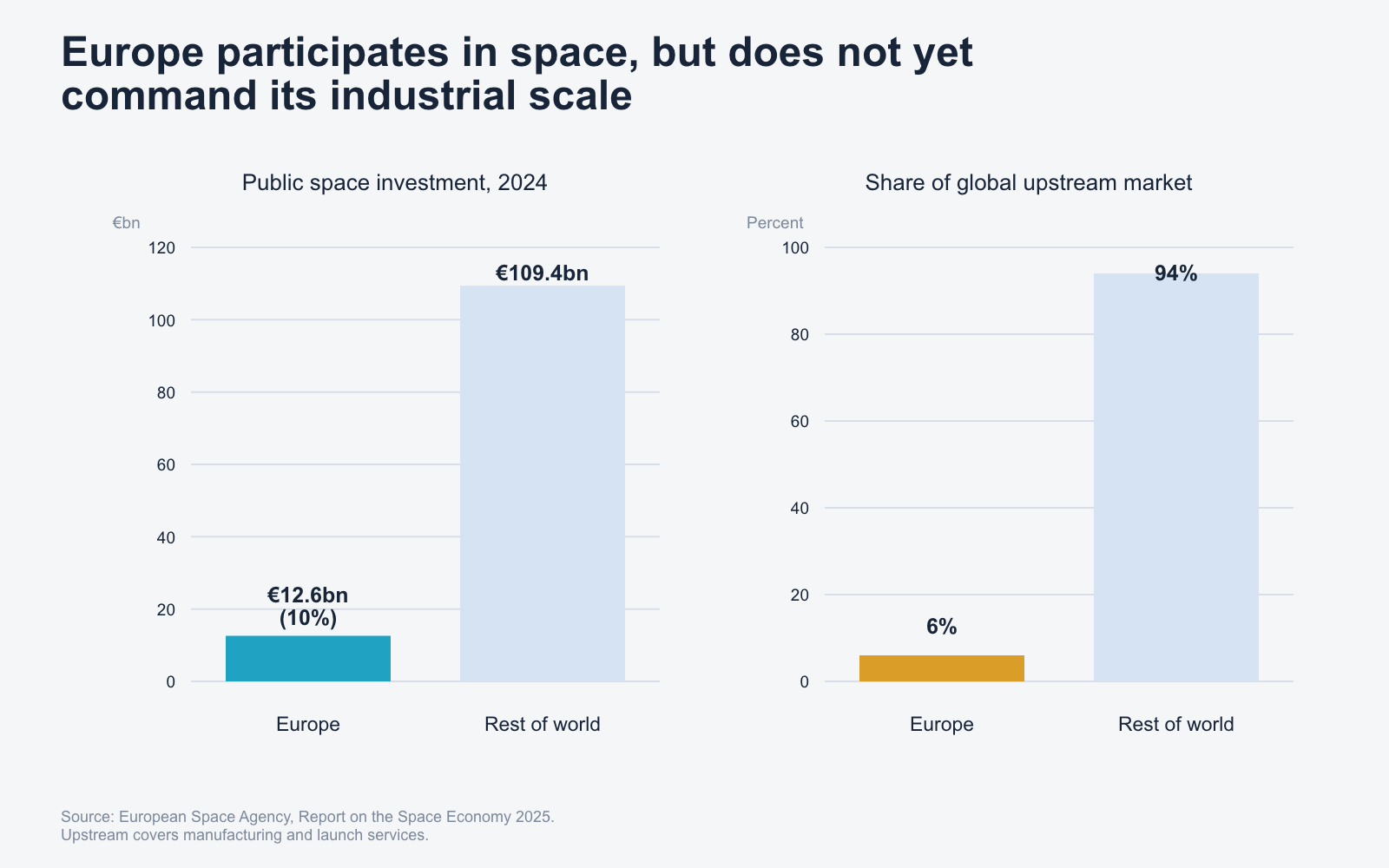
Space belongs in this wager, not as ambition theatre but as a long-duration proving ground. Communications, observation, navigation, climate infrastructure, defence, launch, in-space operations and scientific missions combine software with physical scarcity and sovereignty. In 2024 Europe accounted for about 10% of global public space investment and 22% of private space investment, yet only 6% of the global upstream market for spacecraft manufacturing and launch services.[9] The mismatch is not proof that every European space company deserves funding. It is evidence that public commitment and private capital have not yet translated into proportional industrial scale. The near-term case must rest on real customers and durable infrastructure; the distant prospect of resources cannot justify weak economics today. But if Europe does not finance and own critical space capabilities, it will rent another layer of its future from others.
Why Pyratz must be an investor-builder
Pyratz is being built between venture capital and the holding company because each solves only half the problem. Venture can finance discontinuity but is often forced by fund duration to seek liquidity before an exceptional asset finishes compounding. Permanent ownership can preserve time but drift into passivity. Pyratz combines selective building, founder-led investing and operating proximity with the freedom to hold exceptional assets beyond a fund’s timetable.
Operating proximity is not valuable because investors are wiser than founders. It is valuable because reality produces information that a board presentation cannot: which buyer will actually pay, where deployment fails, which regulation binds, which technical bottleneck persists and which talent is irreplaceable. That information can improve both company-building and the next allocation decision.
Proximity also creates danger. An investor who calls itself a cofounder can become intrusive, emotionally attached or conflicted. Portfolio coherence can become forced commercial relationships, information leakage or a conglomerate discount. The founder must retain authority over the company; shared services must be optional and demonstrably useful; confidential information must be ring-fenced; conflicts must be disclosed; and Pyratz must never use its portfolio power to transfer value from one company to another.
“Investor acting as cofounder” is therefore a standard of effort, not a claim to the founder’s role. Pyratz may accept defined responsibility for recruiting, financing, market access, regulatory preparation, data or technical deployment where agreed with the founder. The founder still leads the company.
The allocation constitution
A broad thesis requires narrow rules. Every investment must clear an adequate financial threshold for its risk, duration and liquidity; demonstrate a durable scarcity or other defensible source of value capture; pass the agency assessment; define the evidence expected at dated milestones; match capital intensity to time-to-proof; secure governance leverage proportionate to the downside; fit portfolio concentration and liquidity limits; and state in advance which evidence would disconfirm the thesis.
Thematic relevance never rescues weak economics. Strategic relevance does not excuse an inadequate expected return. Nor does a high expected return rescue an agency failure. Stage, geography, reserves, follow-on exposure and concentration ceilings will be set at vehicle level because liabilities and mandates differ, but each vehicle must disclose them before capital is committed. Follow-on capital is earned by evidence, not used to protect a prior mark. Permanent holdings face the same review; permanence is an option, not an exemption.
Engagement before exclusion
A doctrine becomes real only when it changes an attractive decision.
Pyratz does not adopt a long prohibited-sector list. Powerful systems often contain both the possibility of sovereignty and the possibility of control. Autonomous defence can protect civilians and infrastructure; the same technical capability can diffuse accountability for lethal force. A dominant platform can create extraordinary consumer value while narrowing competition and manipulating preference. A health company can save lives while deepening inequality.
Our default is engagement first, exclusion when engagement cannot credibly alter the outcome. Engagement is not a discretion exercised by the deal team alone.
Before any such investment, the team must complete a written agency assessment identifying affected people, plausible harms, human benefit, required rights, measurable commitments, milestone dates and disconfirming evidence. A standing Agency Council with members independent of the sponsoring deal team reviews high-risk cases, records assent and dissent, and can block closing even after investment-committee approval. Risk classes carry minimum non-waivable rights. No closing occurs until those rights and commitments are legally documented rather than promised. The Council reassesses high-risk holdings at least annually and after material incidents, and reports exceptions, breaches and remedies to Pyratz’s governing body. Vehicle mandates must recognize this authority in advance.
Active intervention cannot be symbolic. Protections must be enforceable and specific to the business model: interoperability and user control for a centralized platform; data rights and a credible access pathway in healthcare.
For defence, one boundary is categorical: Pyratz will not back a system that selects and engages human targets without accountable human authorization. Defensive autonomy may qualify only within a bounded objective, target class and operating environment, with abortability, auditability, a responsible chain of command and clear liability. Speed does not turn ceremonial oversight into meaningful control.
If Pyratz lacks sufficient leverage, if management rejects the required protections or if the harmful outcome is intrinsic to the business model, we do not invest—regardless of expected return.
If commitments later fail, the response is not reduced to an illusory promise to exit. Pyratz can withhold follow-on capital and operating support; exercise consent, voting, information and audit rights; demand remediation by a fixed deadline; seek board-level or contractual enforcement; and inform the relevant governing bodies or co-investors where legally permitted and necessary to address the breach. Divestment is used when feasible and when transfer is more likely to reduce harm than merely move ownership. If exit is impossible, the breach remains on the public scorecard, no new discretionary capital is committed, and Pyratz continues the enforcement path rather than treating illiquidity as absolution.
This is not moral purity. It is institutional responsibility under uncertainty. Ownership gives Pyratz a place inside the system; governance gives it lawful influence; operating involvement turns influence into action. Without those, “engagement” is merely a rationale for owning what we already wanted to own.
Permanent where the evidence deserves it
Permanent capital is not a promise never to sell. It is the freedom to keep owning what continues to deserve ownership.
Pyratz aims to remain a permanent owner of exceptional assets and an active recycler everywhere else. Permanence must be earned repeatedly, not granted sentimentally. Attachment is not evidence; strategic language is not a substitute for returns.
This discipline matters because the best companies often create most of their value after the timetable of a conventional venture fund demands liquidity. A permanent-capital institution can retain the right tail rather than sell its best information just as compounding begins. But the same structure can hide mistakes. The answer is not forced exits; it is explicit review, independent challenge and the willingness to recycle capital when the thesis breaks.
The apparent contradiction between permanent ownership and broad ownership is productive. Pyratz must concentrate judgment and responsibility without making itself another unaccountable concentration point. Patient assets require patient liabilities; any broad-access vehicle must match them rather than promise liquidity the portfolio cannot support. Over time, regulated participation, transparent governance and clearly separated economic, stewardship and liquidity rights should allow more people to share economically in exceptional assets while Pyratz preserves the stability needed to own them well.
This distinction is not theoretical. European supervisors identify liquidity mismatch—the gap between how quickly investors may redeem and how quickly underlying assets can be sold—as a central risk in open-ended alternative funds.[10] Broad access is credible only when the vehicle’s promise matches the asset’s reality.
The institution as a consequence
Pyratz is not the premise of this argument. It is the institutional response.
No single vehicle can accomplish all of this immediately. The institution must be built in sequence, with each claim bounded by what exists. Company-building, operating support, crossover capital, permanent ownership and regulated distribution should reinforce one another only where evidence proves the connection. A flywheel drawn on paper is not an operating advantage.
By 2036, Pyratz should be judged by facts an outsider can inspect. Pyratz commits to define a scorecard before each vehicle begins investing, report it at least annually, and preserve comparable definitions over time. Vehicle-specific targets may differ, but the framework will include:
• ownership retained and value created from top-performing assets;
• realized and unrealized performance against relevant disclosed benchmarks;
• European strategic rights and capabilities retained, using disclosed categories rather than anecdotes;
• the share of high-risk investments carrying enforceable agency covenants;
• covenant breaches, remediation actions, unresolved cases and exits;
• the contribution and cost of operating support, including founder feedback and related-party transactions;
• broad-access outcomes, including fees, losses, concentration, liquidity and the distribution of economic participation; and
• investments rejected, constrained or deprived of follow-on capital because of the agency boundary.
An independent challenge body must review the reporting methodology and may publish recorded dissent. The purpose is not to convert judgment into false precision. It is to make retrospective storytelling harder.
Financial performance belongs inside that audit. An institution that cannot compound capital cannot preserve independence or finance difficult ambition. But returns alone do not answer whether Pyratz fulfilled its purpose.
Europe has spent too long creating the future and renting it back. Pyratz exists to break that pattern—not by retreating from frontier technology, but by entering it with capital, governance and responsibility. We invest in the technologies creating abundance and in the scarce, regulated systems through which that abundance becomes real. We will build what is missing, back founders who see further, keep what deserves to compound, and walk away when returns require us to weaken the agency we claim to defend.
The intelligence age may make capability abundant. Our work is to ensure that ownership, choice and responsibility do not become scarce with it.
Evidence and reading notes
All figures distinguish observed data from projections. Cross-region comparisons inherit the definitions and coverage of their source datasets; they should not be combined as if they formed one statistical series. Figures have been redrawn by Pyratz from the cited sources to clarify the argument. Values may not sum perfectly because of rounding.
[1] The 2036–2050 corridor is a strategic thought experiment, not a technology forecast or investment timetable. Moon infrastructure, asteroid-resource activity, Mars settlements and consciousness upload have sharply different technical, economic and governance uncertainties. Their inclusion tests whether Pyratz’s ownership and agency doctrine remains coherent under frontier conditions; it does not assert that any will be commercially mature by 2050.
[2] European Investment Bank, The Scale-up Gap: Financial Market Constraints Holding Back Innovative Firms in the European Union, 2024, especially pp. 17–26. The study follows venture-backed firms that reached scale-up status after 2013 and compares EU firms with London and San Francisco cohorts. “More than four in five” refers to the EIB’s reported foreign lead or sole investor share; it is not a measure of foreign ownership of all EU startups.
[3] AI 2027 (Daniel Kokotajlo, Scott Alexander, Thomas Larsen, Eli Lifland and Romeo Dean, 2025) is used as a stress test for compressed decision time and concentrated capability, not as Pyratz’s forecast. AI 2040: Plan A (Thomas Larsen, Romeo Dean, Brendan Halstead, Eli Lifland, Ryan Greenblatt and Daniel Kokotajlo) is used for its distributional question—what replaces wages, bargaining power and ownership if machines perform more valuable work—not as Pyratz’s governance prescription. Its Space Governance Plan informed the long-horizon questions of property, sovereignty and stewardship; Pyratz does not adopt its policy recommendations.
[4] International Energy Agency, Energy and AI, 2025. The 2030 value is the IEA base case, not a Pyratz forecast. The IEA publishes higher- and lower-demand sensitivity cases; hardware efficiency, AI adoption, supply chains and grid bottlenecks remain material uncertainties.
[5] European Central Bank, “Introductory statement in three charts”, 30 September 2024, based on OECD and ECB calculations; latest observation 2022. The comparison covers financial assets, not housing or other non-financial wealth, and does not imply that the US allocation is an optimal template for every household.
[6] OECD, Algorithmic Management in the Workplace: New Evidence from an OECD Employer Survey, 2025. The survey covers France, Germany, Italy, Japan, Spain and the United States and reports managers’ perceptions; it does not by itself establish causal effects on workers.
[7] European Commission, OECD and WHO European Observatory on Health Systems and Policies, State of Health in the EU: Synthesis Report 2025, pp. 26–28. Retail pharmaceutical shares refer to 2023. Catastrophic-spending estimates use WHO Europe methodology and should not be read as the share of households bankrupted by medical costs.
[8] European Investment Bank, Investment Report 2025/2026: Capitalising on Europe’s Strengths, Chapter 5, Figures 8–9. Venture-capital shares aggregate 2014–2024 and classify company location by headquarters. “Other Europe” includes the United Kingdom, Switzerland and Norway. Listed-company ownership is based on the origin of the top 20 investors.
[9] European Space Agency, Report on the Space Economy 2025, pp. 5–6. Public and private investment shares and upstream market share refer to 2024. The upstream market covers manufacturing and launch; downstream services are much larger and Europe held a reported 19% global share.
[10] European Securities and Markets Authority, “ESMA report highlights liquidity concerns for Alternative Investment Funds”, 3 February 2022; see also ESMA’s 2024 analysis of leveraged AIFs. The cited risk is structural and does not imply that every open-ended fund has a material mismatch.
The Software Factory
Agentic coding is changing the unit of software production: the developer increasingly designs, supervises, and improves a factory of connected build, audit, deployment, and operating systems.
Extensible Software in the Agentic Age
Coding agents make extensible software more valuable: more users can now turn small, personal workflow frictions into working tools.
Context Switching Is the Work
Agentic coding changes the developer's job: less uninterrupted implementation, more dispatching, reviewing, and switching well between parallel streams of work.